For most people, a church's website is the first visit. Long before someone walks through the doors on a Sunday morning, they've already looked the church up on their phone, usually late at night, usually wondering whether they'd fit in. What they find there decides whether they ever show up.
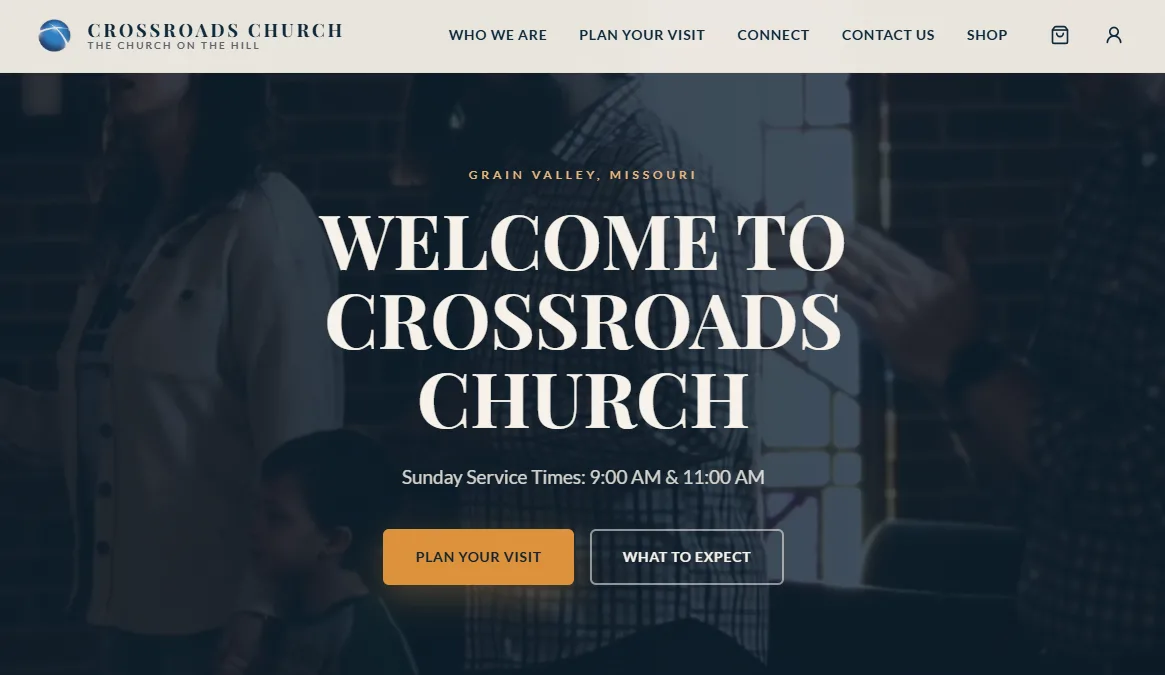
That was the starting point for the new website for Crossroads Church in Grain Valley, Missouri, at direction4living.com. We designed it. The church filled it with its own words, and that's the part we're proudest of.
Who Crossroads is
Crossroads is a nondenominational, Elder-led church that meets Sundays at 9:00 and 11:00 AM, with a midweek gathering on Wednesday evenings. Families worship together in the same room, kids included, and people stick around afterward for coffee and conversation. The church's goal is simple: help people find and follow Jesus.
The website's job was to get that across to someone who has never been there, in plain language, without church jargon.
We designed it. They built the content.
Most churches don't have a web developer on staff. They have an administrator who is already juggling the bulletin, the calendar, volunteers, and a dozen other things. Usually that means the website either gets handed to an outside agency, with every small change becoming a request and a wait, or it just doesn't get touched.
We split the work differently. ServingTheBest handled the design: the look, the layout, the page structure, and the pieces a church needs, like staff bios, events, FAQs, a photo gallery, giving, and forms. Then we handed the church administrator the keys.
From there, the administrator wrote and built most of the content, with help from an AI assistant that runs in their web browser (Claude, in their case). They could ask it in plain English, something like "add a page explaining what to expect on a Sunday," watch it fill in the page right in our admin screens, then review it and put it in their own voice.
That only works because of how the admin is built. Every screen uses clear labels, plain-language instructions, and simple, predictable forms. That makes it easy for a busy person to figure out on their own, and it turns out the same things make it easy for an AI assistant to work in, too. We didn't have to build anything special for it. A website dashboard that's simple enough for a non-technical person is simple enough for AI to help with.
The result is a site that looks professionally designed and sounds like the church, because the church wrote it. When service times change or a new ministry starts, they don't need to call anyone. They just update it.
What's on the site
A clear path for first-time visitors
The most important button on the site says Plan Your Visit, and it shows up again and again on the home page. Next to it is a What to Expect page that walks a newcomer through a Sunday morning before they arrive, so the first visit doesn't feel like a guessing game.
Service times, the address, and a one-tap link for directions sit right on the home page. Someone deciding at 8:30 on a Sunday morning shouldn't have to hunt for when church starts.
Answers to the common questions
A short FAQ section covers what kind of church Crossroads is, when and where it meets, what a service is like, and how to get connected. These are the exact questions people type into Google, and answering them on the page helps the church show up for those searches.
Sermons from the tools the church already uses
Crossroads already publishes its messages through Planning Center, a church management tool many churches rely on. Instead of uploading every sermon twice, the website links straight to the latest message. When the church posts on Sunday, the website is current automatically.
Giving, students, and getting connected
The site includes pages for online giving, the student ministry, and a Connect page for people ready to take the next step. There's also a small online shop. Each of these is a clear next step for someone who's already visited and wants to get more involved.
Built for phones first
Most people look up a church on a phone. The site reads comfortably on a small screen, with the phone number and directions one tap away.
Why this matters for any church
Many church websites are built for the people who already attend, and many are stuck because only one outside person knows how to change them. If your church's website is due for a refresh, a few questions are worth asking:
Can a first-time visitor find your service times and address in a few seconds?
Do you explain what a Sunday is actually like, including what happens with kids?
Are your sermons and events pulled in from the tools you already use, or copied by hand?
Can your own staff update the site without calling someone?
Take a look at the new Crossroads Church site at direction4living.com. And if you're in the Grain Valley area, they'd love to see you on Sunday.